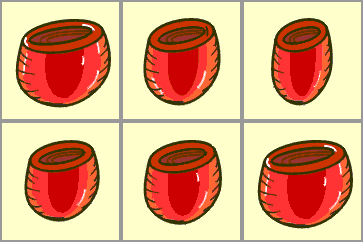
 Answer (a) Dilation, Volume overload is correct!
3. Volume overload. Shunts, Aortic regurgitation, and congestive heart failure are all are examples of volume overload that dilate the heart. The pressure is not necessarily high: it just has to pump lots of blood. But according to Laplace's law, it cannot generate as much pressure as a hypertrophied heart.
An LV that is dilated too thin could rupture - according to Laplace's law. So some hypertrophy thickens the wall to keep the ratio of wall thickness to LV radius normal. For this reason, we seldom see pure dilatation. Dilation is a "series" replication of myofibrils. As increasing volume stretches the LV, it adds myofibrils onto the ends of others (in series) and thus lengthens them.
See: Todd's, Vol I, #629 and Braunwald, chapter on "Pathology of Heart Failure."
Keywords:
CHF, Pressure & volume overload, dilatation
